

Sajan Vazhakaparambil Kolavan Kalyanikutty Mani is an artist whose practice interrogates the intersections of performance, archives, and Dalit consciousness. A central theme in his work is the reverberation of ancestral voices, critically engaging with the weight of colonial history and its contemporary manifestations.

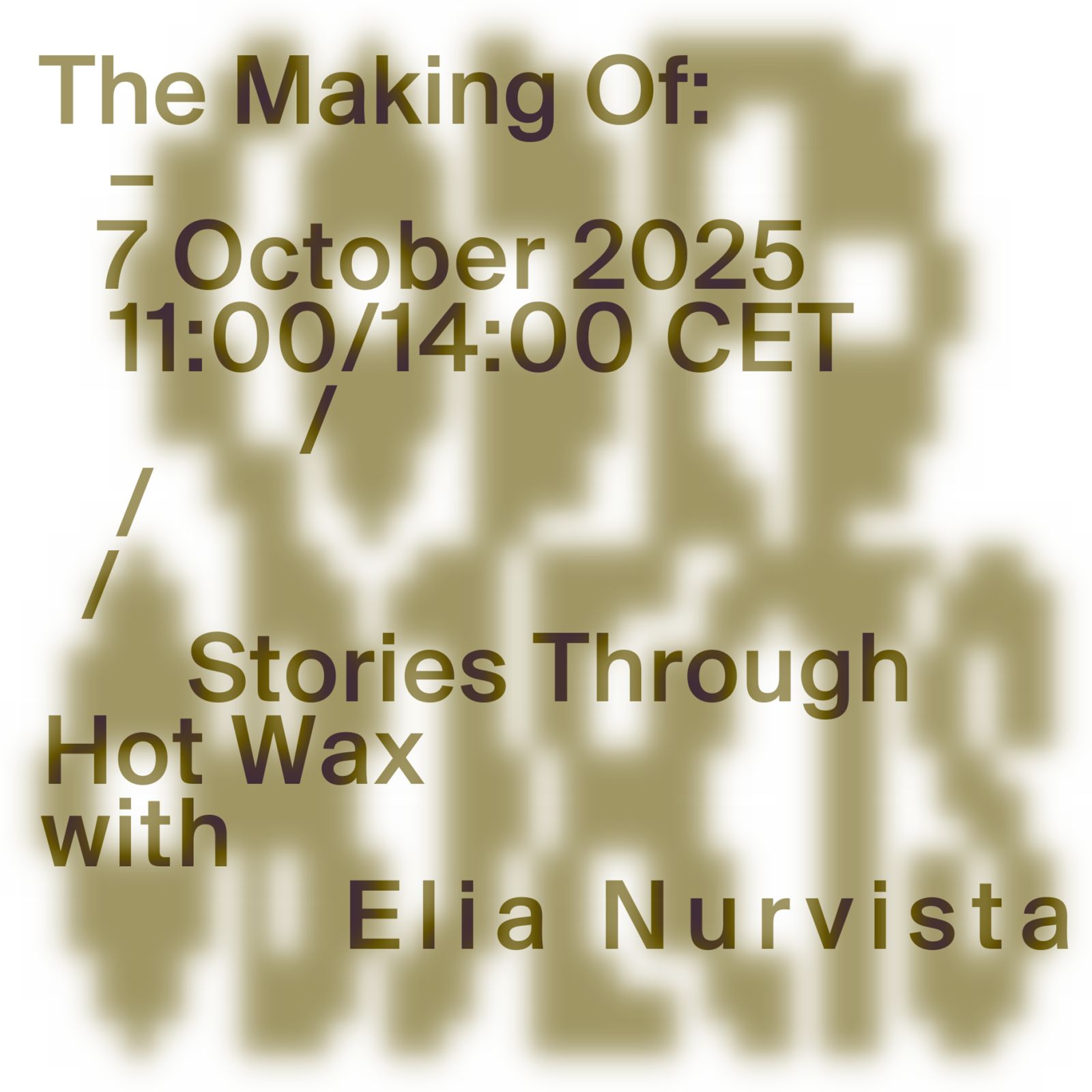
Elia Nurvista is an artist whose practice critically engages with food politics to examine power structures, social hierarchies, and economic inequalities. Through a diverse range of mediums—including workshops, study groups, publications, site-specific works, performances, video, and installations—she explores the social and political implications of food systems, addressing broader issues such as ecology, gender, class, and geopolitics.

Chaveli Sifre is a multidisciplinary artist whose practice explores healing traditions, the hierarchy of the senses, botany, and the belief systems that shape them. Through installations, sculptures, paintings, and participatory performances, she investigates the intersections of science, spirituality, ritual, and healing modalities, seeking to recover their long-lost connections.

Raul Walch is a visual artist whose practice is driven by political and ecological engagement. After studying Sculpture at Kunsthochschule Berlin-Weißensee, he completed his studies in the class of Olafur Eliasson at UdK, Berlin, and was later a fellow at the Institut für Raumexperimente. His work often takes the form of sails, mobiles, kites, and flags, created through collaborative and performative processes.
.jpg)
On the occasion of the 120th anniversary of Villa Romana, the Museo Novecento, in collaboration with Villa Romana, presents the exhibition CENTOVENTI: Villa Romana 1905–2025, curated by Elena Agudio and Sergio Risaliti, with Mistura Allison and Eva Francioli. The exhibition will be open to the public from 26 October 2025 to 8 March 2026 in the first-floor galleries of the Museo Novecento.
Since its foundation, Villa Romana has stood out as a free and independent space, devoted to artistic experimentation and international exchange, apart from academic paradigms. Over time, this mission has evolved into support for a younger, more experimental art, capable of opening pathways towards the future and of building new traditions through critical reflection on both past and present.
The exhibition project seeks to explore the ongoing dialogue between the residence in Via Senese and the city of Florence, highlighting the role Villa Romana has played in generating relationships, influences, and original visions, while positioned at an apparently marginal distance from the historic centre. Through an extensive residency programme, since 1905 the Villa has hosted artists and intellectuals who, by living and working within its walls, have helped transform it into a laboratory of experimentation and openness towards the contemporary world.
The exhibition at the Museo Novecento thus represents a unique opportunity to historicise, for the first time in an Italian museum, the presence and activities of Villa Romana throughout the twentieth century and up to the present day. On display will be archival materials and works by some of the key figures who have marked the life of the institution, including Ernst Barlach, Georg Baselitz, Max Beckmann, Michael Buthe, Max Klinger, Georg Kolbe, Käthe Kollwitz, Markus Lüpertz, Anna Oppermann, Max Pechstein, and Emy Roeder. The works come from the Villa Romana collection as well as from major museums and institutions in Italy and abroad.


.png)
%C2%A9photoElaBialkowskaOKNOstudio.jpg)


